How Bartr Is Changing the Way Musicians Trade Gear Online
Published on July 31, 2026If you have ever tried to swap a guitar for a synth or trade a pedalboard for a bass amp, you already know the drill. The online gear trading process looks simple on paper: find someone who wants what you have, agree on values, ship the boxes, and enjoy your new setup. In reality, it rarely goes that smoothly. Messages go cold. Condition details get fuzzy. Someone disappears right when it is time to drop off the package. Musicians have been piecing together trades on platforms that were never built for swaps, and the frustration has been building for years. But in 2026, that experience is finally getting a long-overdue rewrite.
Table of Contents
- The Problem with Trading Gear the Old Way
- Why Online Gear Trading Needs a Different Approach
- What a Purpose-Built Trade Platform Looks Like
- How Secure Trade Facilitation Changes the Experience
- What This Means for Musicians in 2026
- Getting Started with a Better Way to Trade
The Problem with Trading Gear the Old Way
Most online marketplaces were designed for one thing: a buyer sends money, a seller ships an item, and the transaction closes. That model works fine for cash sales, but a trade is a completely different animal. When two pieces of gear change hands, there is no payment processor acting as a referee. There is no receipt. There is just two strangers, two shipments, and a handshake agreement held together by hope.
The old workarounds have always been clunky. Musicians post listings on classifieds boards and add “open to trades” in the description, then negotiate through a tangle of direct messages, text threads, and email chains. Shipping addresses get buried. Condition questions go unanswered for days. One person ships immediately while the other waits a week, and suddenly the whole deal feels lopsided. The risk doubles because both sides are simultaneously buyer and seller, and neither has any real protection if the other person flakes.
Then there is the gear itself. A guitar described as “mint” might arrive with fret sprout and a scratchy input jack. A vintage drum machine might power on but have a failing memory battery that wipes your patterns overnight. In a cash sale, you can dispute the charge or request a return through the platform. In a handshake trade, you are often stuck with what you get. Musicians end up spending more mental energy worrying about whether the trade will go sideways than actually getting excited about the new gear. That anxiety defeats the whole point of refreshing your rig in the first place.
Why Online Gear Trading Needs a Different Approach
Trust Can’t Be an Afterthought
Most platforms treat trust as something that magically appears between two people who share a hobby. The thinking goes: you are both musicians, so you will probably be cool to each other. Anyone who has been burned knows that is not enough. Trust needs structure. It needs a system that verifies who you are dealing with and gives you a reason to believe the other person will follow through.
When a platform bakes accountability into every step, the dynamic shifts. You are not just hoping the other trader is honest. You can see their history. You can read feedback from previous trades. You know that if something goes wrong, there is a process for addressing it rather than a dead-end inbox. That kind of structure does not just protect against bad actors. It also encourages everyone to be more careful and communicative, because their reputation is on the line. One bad experience on an unprotected platform can sour a musician on trading forever. A single smooth trade on a well-built platform does the opposite. It opens the door to a whole new way of cycling gear without draining your bank account.
Value Is Tricky When Gear Isn’t Identical
Cash sales have a clear anchor: the price tag. Trades operate in a grayer zone. A limited-run overdrive pedal and a mid-tier acoustic guitar might both feel like a fair swap to the people involved, but agreeing on that fairness requires more than gut instinct. One person might be looking at completed listings from six months ago, while the other is checking current retail prices. Neither reference point tells the full story.
Without a shared understanding of value, trades can leave a bad taste even when both items arrive in perfect condition. Someone walks away feeling like they gave up too much. The other person wonders if they could have asked for more. Those feelings fester, and they make musicians hesitant to trade again. What online gear trading needs is a way to establish fair exchange ranges before anyone commits to boxing up their gear. Not rigid pricing algorithms that ignore condition and rarity, but thoughtful suggestions that give both parties a starting point for honest negotiation. When value is clear from the beginning, the trade feels good on both ends, and that satisfaction builds momentum for future swaps.
Communication Needs to Stay Organized
A trade negotiation has more moving parts than a simple purchase. You are coordinating two shipments instead of one. You are comparing condition notes on two items. You might be discussing hard cases, original packaging, power supplies, or whether that aftermarket pickup swap affects the value. When those conversations scatter across Instagram DMs, text messages, and email threads, details slip through the cracks.
A dedicated messaging system built into the trade platform keeps everything in one place. You can scroll back and confirm what was agreed on. You can share photos without switching apps. You can set expectations about shipping timelines and packaging requirements without worrying that the other person missed a message buried in their spam folder. Organized communication is not just a convenience. It is a safeguard. When both parties have a clear record of what was promised, there is less room for misunderstanding and less chance that a deal falls apart over something that could have been clarified with a single message.
What a Purpose-Built Trade Platform Looks Like
A platform designed from the ground up for trading removes the friction that musicians have been tolerating for years. Instead of retrofitting a cash-sale system with awkward workarounds, every feature serves the specific flow of a swap.
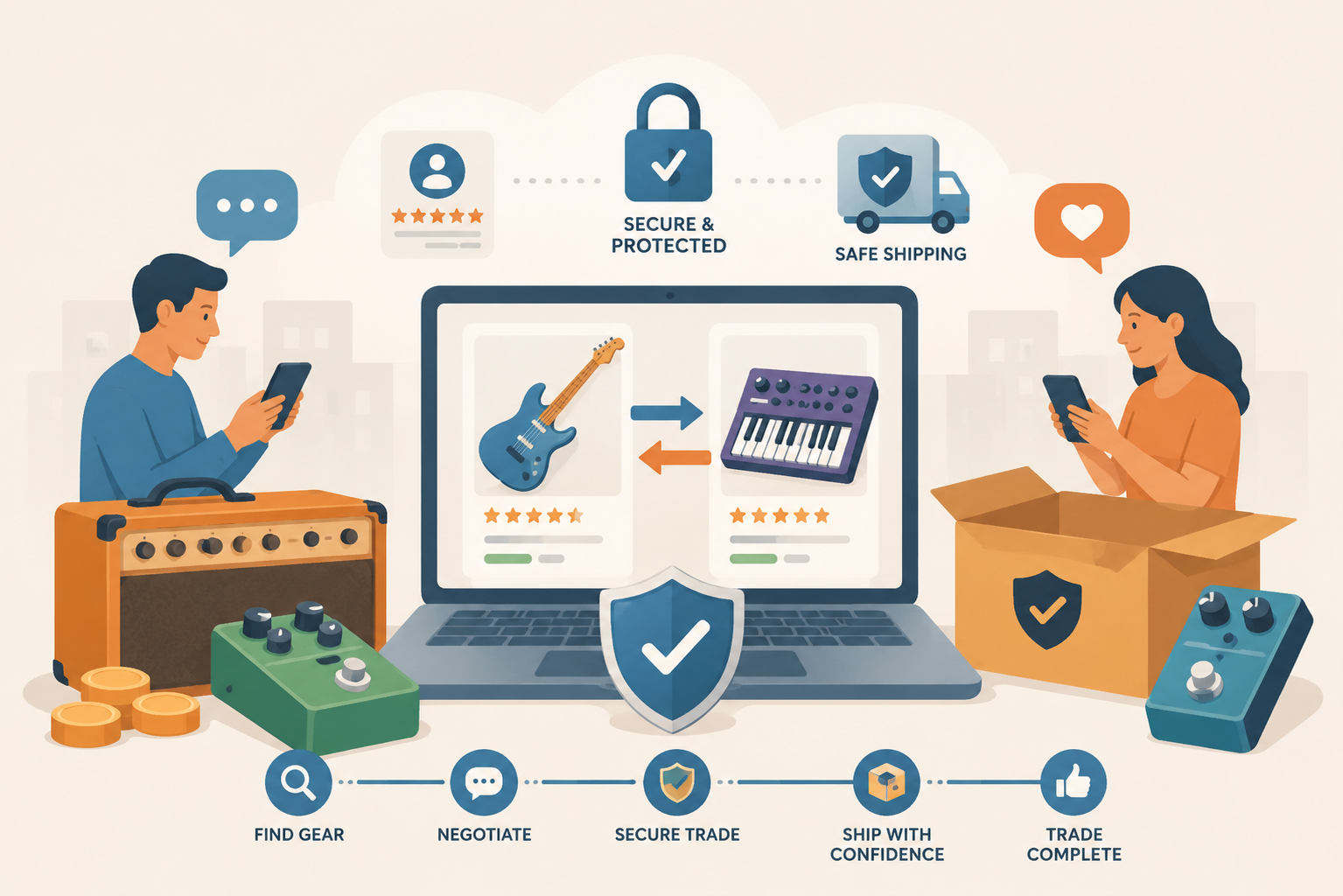
User profiles and ratings give musicians a way to build reputation over time. When you complete a trade, the other person can vouch for your communication, your shipping speed, and the accuracy of your listings. That reputation follows you into every future trade, so you are not starting from zero trust with each new connection. The community polices itself in the best way: honest traders get rewarded with smoother deals, and anyone who consistently causes problems finds it harder to find partners.
Trade value suggestions help both parties agree on fair exchange before they commit. Instead of haggling in the dark or relying on outdated price guides, musicians can see reasonable ranges that reflect real market conditions. That clarity reduces the back-and-forth and prevents the post-trade regret that comes from feeling like you misjudged the deal.
Structured listing and browsing tools make it easy to find exactly what you are looking for. You can browse by category, whether that means electric guitars, synths and sound design gear, or guitar and bass effects pedals. You can see what other musicians are offering for trade and get a sense of the market before you even list your own gear. A mobile-friendly interface means you can check new listings, respond to messages, and manage active trades from the practice room, the studio couch, or the back of the van between tour dates. The platform fits into a musician’s life instead of demanding that life pause for a desktop session.
How Secure Trade Facilitation Changes the Experience
The biggest shift in online gear trading comes when a platform stops being a passive listing board and starts actively facilitating the trade process. That facilitation is what separates a structured swap from a handshake deal between strangers.
When a platform provides clear processes for listing condition, sharing detailed photos, and confirming item details before shipping, the risk of misrepresentation drops dramatically. Both parties know exactly what is expected of them. Packaging requirements are spelled out. Shipping timelines are agreed upon and tracked. There is no ambiguity about who ships first or what happens if a delivery gets delayed. Accountability runs through the entire transaction, not just the initial negotiation.
If something does go wrong, having a structured process means there is a path to resolution. In an unprotected trade, a damaged item or a misrepresented condition leaves you with few options beyond angry messages and forum warnings. With secure trade facilitation, there is a framework for addressing problems. That safety net does not just protect you when things go sideways. It also makes you more willing to trade in the first place, because you know the platform has your back. Musicians can browse listings, propose swaps, and ship their gear with confidence, which opens up possibilities that felt too risky under the old model.
What This Means for Musicians in 2026
The landscape of online gear trading has shifted significantly in the last few years. Musicians are no longer satisfied with listing boards that leave all the risk on their shoulders. They want platforms that understand the unique dynamics of swapping instruments and equipment, and they are finding them.
Purpose-built trade platforms are replacing the old workarounds. Trades that used to take weeks of scattered communication now happen in days. Deals that would have fallen apart over trust issues now close smoothly because both parties can see each other’s history and ratings. The transparency that comes with structured facilitation means fewer surprises and fewer disappointments. Musicians can focus on what actually matters: finding the right gear, connecting with other players who share their passion, and getting back to making music.
The barrier to trading has lowered, too. You do not need to be a seasoned marketplace veteran with dozens of transactions under your belt to make a successful swap. The platform guides you through the process, and every completed trade adds to your reputation, making the next one even easier. Community ratings mean that trust compounds over time. Honest traders rise to the top, and the whole ecosystem gets healthier as a result. In 2026, trading gear online feels less like a gamble and more like a natural part of being a musician.
Getting Started with a Better Way to Trade
Joining a purpose-built trade platform is straightforward. Signing up is free and takes just a few minutes, so there is no upfront commitment that keeps you from exploring what is available. Once you are in, browsing the listings gives you a real sense of what other musicians are offering and what kinds of trades are happening right now.
Creating a profile with accurate information about your own gear helps potential trade partners find you. When someone can see what you have and read about its condition, they are more likely to reach out with a serious offer. The first trade always feels like the biggest leap, but the structured process makes it manageable even if you have never swapped gear online before. Every successful trade builds your reputation, and that reputation makes future swaps faster, smoother, and more rewarding. The goal is not just to move gear. It is to build a community where musicians can refresh their setups without the stress, the scams, or the second-guessing that defined the old way of doing things.