Secure Guitar Swap Service That Works
Published on June 14, 2026Most guitar trades fall apart in the same predictable ways. One person disappears after agreeing on terms, the other ships late, or the guitar that shows up is not quite the one described in the messages. That is exactly why a secure guitar swap service matters. If you are trading with someone you do not know, excitement about new gear is never enough on its own.
A good swap should feel clear from the start. Both sides should know what is being traded, what condition it is in, when it ships, how delivery gets confirmed, and what happens if something goes wrong. Without that structure, even a fair trade can turn messy fast.
What a secure guitar swap service actually does
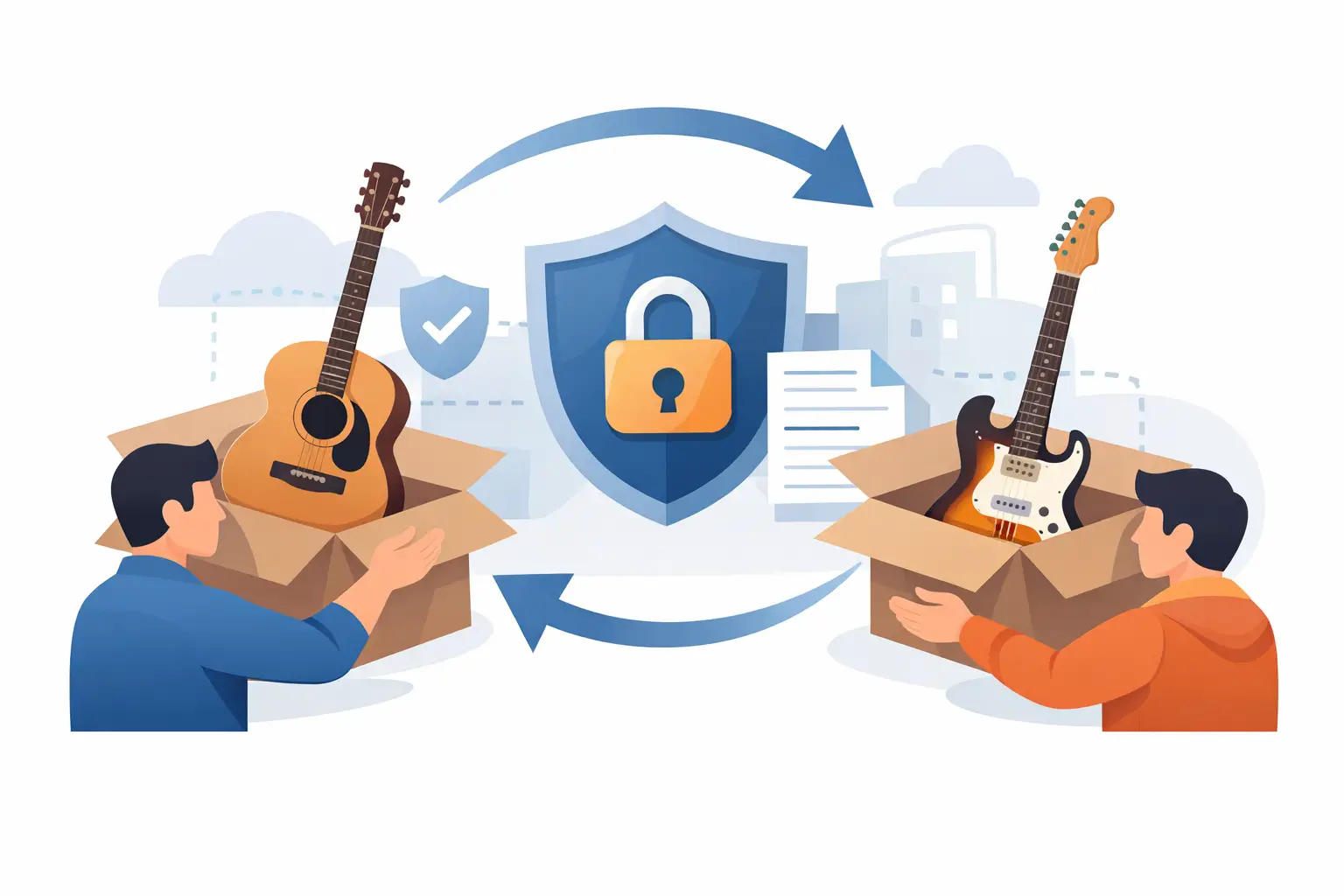
At the simplest level, a secure guitar swap service gives a guitar trade rules, proof, and accountability. Instead of relying on screenshots, vague promises, and crossed fingers, both traders move through the same process with documented terms.
That changes the whole experience. The trade is no longer just two strangers hoping the other person follows through. It becomes a managed exchange with checkpoints. Deposits can help both sides stay committed. Delivery confirmation helps verify that each item actually arrived. Reputation tools and reviews give useful context before anyone agrees to swap. And if there is a dispute, there is a process for handling it that does not depend on whoever types the longest message.
For musicians, that structure matters because guitars are rarely simple one-size-fits-all items. Condition, modifications, setup, finish wear, replaced hardware, fret life, and case inclusion all affect value. A platform built around swaps should account for that reality rather than treat a guitar like any other used household item.
Why informal guitar trades go wrong
The biggest problem with informal trading is not just fraud. It is ambiguity.
A seller might say a guitar is in great shape, but one person means light pick marks while another means a repaired headstock and some buckle rash. Someone might agree to ship in a hard case, then send it in a gig bag inside a thin box. A trade partner might sound reliable for three days, then vanish the moment tracking gets requested.
Cash sales already carry risk. Swaps can be even trickier because both sides are sending value at the same time. There is no clean buyer-seller line. Each person is both giving something up and waiting on something in return. That doubles the points where a trade can break down.
This is where musicians usually get frustrated with generic marketplaces and social groups. They can help people find gear, but they do very little to protect the swap itself. Discovery is not the hard part. Trust is.
What to look for in a secure guitar swap service
If you are comparing options, the best secure guitar swap service is not the one with the loudest safety claim. It is the one that makes the trade more accountable in practical ways.
Start with structured terms. Both sides should be able to clearly agree on the exact items involved, condition details, accessories included, and any cash added to balance value. If those details live only in a chat thread, problems become harder to resolve later.
Next, look for a deposit system or another commitment mechanism. This helps reduce ghosting and last-minute flaking. Not every trade needs the same level of commitment, but some form of skin in the game matters when both parties are shipping valuable gear.
Delivery confirmation is another must. A secure service should not leave users arguing about whether something arrived. It should provide a clear way to verify receipt so the trade can move to the next step.
Reputation signals also matter, but they are not magic. Reviews and ratings help you spot patterns, especially with communication and accuracy of listings. Still, even a good reputation system works best when paired with real process controls. Five stars are useful. They are not a substitute for documented protection.
And finally, there should be human dispute support. Not canned replies. Not a form that disappears into a queue. Real humans, looking at the agreed terms and shipment evidence, make a huge difference when a trade does not go as planned.
Secure guitar swap service vs. direct person-to-person trades
Direct trades can work. Plenty of musicians have swapped gear that way for years. If both people are local, responsive, and honest, the process may be simple enough.
But simple is not the same as safe.
With a direct trade, you are responsible for everything: checking credibility, documenting condition, setting terms, managing shipping risk, and dealing with any dispute alone. That may be fine for a lower-value pedal. It is a different calculation for a guitar worth hundreds or thousands of dollars.
A secure guitar swap service adds friction in the right places. You may spend a little more time documenting the item or confirming steps, but that friction helps prevent much bigger problems later. For most musicians, that is a trade worth making.
The only real downside is that structure can feel less casual. If you are used to loose, message-based deals, a protected process may seem more formal at first. But when valuable gear is involved, formality is not the enemy. Confusion is.
Why guitar swaps need gear-specific protection
Guitars are personal. Two instruments with the same model name can play very differently, hold value differently, and attract very different kinds of buyers or traders.
That is why a gear-specific marketplace has an advantage over a general resale platform. A musician listing a Strat with upgraded pickups, a refret, and a replaced bridge is speaking to details that another musician understands immediately. The same is true for neck profiles, weight, original parts, and non-original finishes. A secure swap process should support that level of specificity.
This also helps with fairness. A guitar trade is not only about preventing scams. It is about reducing the chance of bad-fit swaps based on poor descriptions or missing details. Better listings and clearer standards lead to better matches.
That is a big reason musicians use platforms like Bartr. The goal is not just to find someone willing to trade. It is to trade smarter, with built-in protection that reflects how musicians actually evaluate gear.
How to make any guitar swap safer
Even with a secure guitar swap service, the user still matters. Good systems reduce risk, but they work best when both traders are thorough.
Write honest descriptions. Photograph the actual wear. Call out repairs, replaced parts, setup quirks, and anything a reasonable guitarist would want to know before saying yes. If the guitar has a dead spot, a scratch near the input jack, or a case latch that sticks, say so.
Be realistic about value. A lot of swap tension comes from one side treating sentimental value as market value. Your upgraded electronics may matter, but they do not always add dollar-for-dollar trade value. The cleaner and more current your valuation is, the easier it is to find a fair deal.
Communicate clearly and keep everything documented. If terms change, update them properly. If shipping gets delayed, say so early. Reliability is not just about good intentions. It is about making sure both sides are looking at the same version of the trade.
Pack like the guitar needs to survive a bad day in transit, not a perfect one. Even the best swap service cannot stop a poorly packed instrument from taking damage.
The real value of a secure guitar swap service
The real value is not only fraud prevention. It is confidence.
When musicians feel protected, they are more willing to trade for the gear they actually want instead of settling for whatever is local or easy. They can refresh a rig, try a different style of instrument, or move an underused guitar into something that fits better without feeling like they are gambling.
That changes behavior. Safer systems create more completed trades, better communication, and a stronger marketplace overall. People list more honestly when they know terms are documented. They follow through more consistently when there are consequences for flaking. And they come back when the process feels fair.
For anyone serious about trading online, that is the difference that matters. Not hype. Not volume. Just a process that respects your gear, your money, and your time.
If you are thinking about your next trade, do not just ask whether the other person seems trustworthy. Ask whether the process is trustworthy too. That is usually where the smart swap starts.