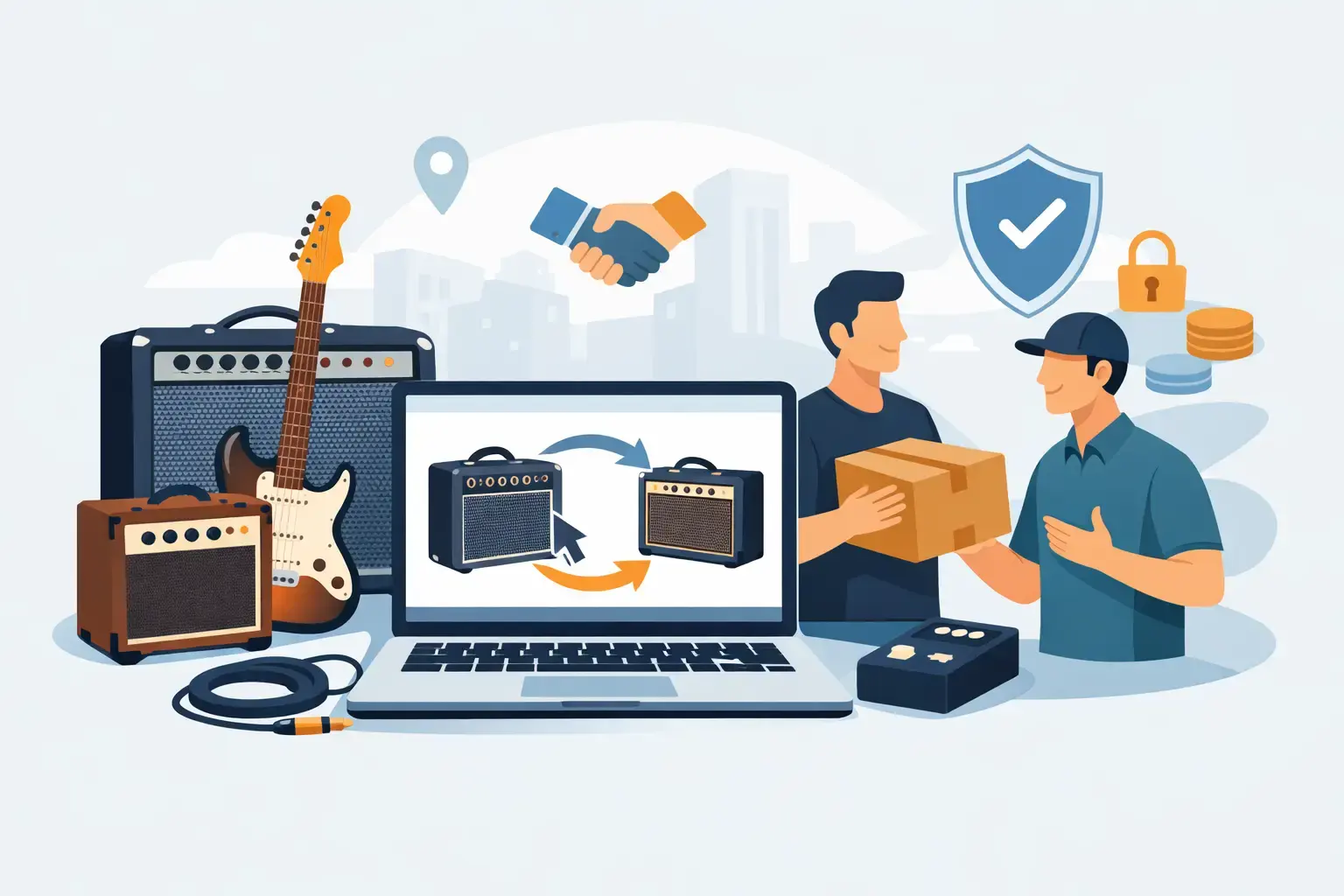
Where to Trade Guitar Amps Safely
Published on May 18, 2026Your amp still sounds great. It just does not sound like you anymore.
That is usually when the search starts for where to trade guitar amps. Maybe your combo is too heavy for regular gigs, your high-gain head is overkill for home use, or you want to turn one solid amp into something that fits your current setup better. Trading can make more sense than selling for cash and starting over, but the best place to trade depends on what you care about most: speed, value, selection, or protection.
If you have ever dealt with vague listings, last-minute cancellations, or someone insisting their amp is in “mint” condition right before it arrives with a blown speaker, you already know the problem. Trading gear is exciting when it works and exhausting when it is handled through random messages and loose promises.
Where to trade guitar amps depends on the risk you will accept
There is no single best answer for every player. A local music shop, a general classifieds site, a social media gear group, and a dedicated music gear marketplace all solve different problems. The right choice comes down to how much convenience you want, how much value you are trying to keep, and how much uncertainty you are willing to deal with.
Local stores are the easiest starting point if you want a fast, low-effort trade. You bring in your amp, the staff tests it, and they tell you what they can offer. That simplicity has value, especially if you are trading a common model and want to walk out with something new the same day. The trade-off is predictable: stores need margin, so the value you get is usually lower than what you might get in a direct peer-to-peer swap.
General classifieds can offer more flexibility and potentially better value. You may find someone nearby who wants exactly what you have and owns exactly what you want. But this is where most of the friction shows up. Conversations stall. People disappear. Item descriptions get fuzzy fast. And if you are shipping, the risks multiply unless both sides agree on clear terms and actually follow them.
Social platforms and gear groups can feel more community-driven, and sometimes they are. Musicians tend to trust other musicians more than anonymous buyers. Still, trust based on shared interests is not the same as transaction protection. A profile picture, a few mutuals, or some casual group activity does not protect you if the other person misrepresents the amp or stops responding mid-trade.
Dedicated music gear marketplaces sit in the middle of value and safety. They are built for the reality of trading instruments and audio gear, not just dumping used stuff online. That matters because an amp trade has more moving parts than a cash sale. Condition, functionality, tubes, speakers, modifications, shipping, timing, and matched value all need to be handled clearly.
The best places to trade guitar amps
If you are narrowing down where to trade guitar amps, start by deciding which of these situations sounds most like yours.
Trade at a local music store if speed matters most
A shop is practical when you want to avoid messaging strangers, packing an amp, or negotiating with five different people. It is especially useful for smaller combos, widely known models, and gear that is easy for a store to resell.
The downside is value. A shop is not trading for your benefit alone. It has to inspect, price, display, and resell the amp while still making money. If your main goal is getting the most out of your current amp, a store trade-in usually leaves money on the table.
Still, for some players that is worth it. If your amp has been sitting unused for months and you want a clean, fast swap, the convenience can beat holding out for a perfect trade partner.
Use local classifieds if you want a face-to-face swap
Local listings can work well when both traders can meet in person, test the amps, and agree on the exchange on the spot. That removes some of the uncertainty around shipping damage and delayed delivery.
But this route depends heavily on the other person being organized, honest, and serious. Many are not. You may spend days answering questions from people who never intend to meet. You may also run into mismatched expectations about condition, cash added on top, or whether a repaired amp was disclosed properly.
If you go this route, details matter. Meet in a safe place, test everything, document the agreed terms in writing, and do not rely on verbal assurances.
Use music-focused trading platforms if you want more structure
This is often the strongest option if your priority is a fair swap without the usual chaos. A platform designed for musicians gives you listings built around actual gear categories, condition details, and trade matching instead of generic marketplace clutter.
More important, the good ones add safeguards around the transaction itself. That can include verified terms, deposits, delivery confirmation, reviews, reputation signals, and access to real human help if something goes sideways. Those features are not there for marketing. They solve the exact problems that make amp trades risky between strangers.
For example, if one person ships and the other delays, or if the received amp does not match the listing, a structured process gives both sides a standard to work from. That is a huge improvement over trying to settle a gear dispute in private messages.
A platform like Bartr is built around that kind of protection. For musicians who want to trade gear instead of just sell it, that structure can be the difference between a smooth upgrade and a frustrating mess.
What makes an amp trading platform actually worth using
Not every gear marketplace is equally useful for amp trades. Some just gather listings. Others create accountability.
The first thing to look for is clear trade structure. Can both sides define exactly what is being exchanged, including any cash difference, accessories, and condition notes? If the terms are vague, the trade can fall apart even when both people started with good intentions.
The second is proof and confirmation. Amp trades are not casual when shipping is involved. You want a process that confirms who sent what, when it was delivered, and whether the gear matched the agreement closely enough to complete the deal fairly.
The third is reputation. Reviews and scores are not perfect, but they are better than nothing. They give you context before you hand over a valuable piece of gear to someone you have never met.
The fourth is dispute handling. This is where many platforms fail. If there is no real process when something goes wrong, then all the nice interface design in the world does not help. Real humans, clear evidence, and a defined resolution path matter more than flashy features.
How to get a better guitar amp trade
Where you trade matters, but so does how you present your amp. Better listings attract better offers.
Be precise about condition. If the tolex is torn, say it. If the tubes were replaced six months ago, include that. If the speaker is not original, mention it clearly. Serious traders do not expect a used amp to be perfect. They do expect honesty.
Photos should show the front, back, control panel, serial area, and any wear. If there are mods or repairs, document them. A detailed listing does more than build trust. It filters out weak offers from people who were never a fit.
It also helps to know your trade target before you list. Are you moving from a loud tube combo to a smaller recording amp? From a clean pedal platform to a lunchbox head? From one amp into a multi-item trade involving pedals or cash? The clearer you are, the easier it is to find the right match instead of getting buried in random offers.
Finally, be realistic about value. A trade is not just about original retail price. Brand demand, condition, service history, portability, and local market interest all affect what an amp is worth in practice.
So, where should you trade your guitar amp?
If you want the fastest and simplest option, a local music shop is hard to beat. If you want to maximize value and keep the trade local, classifieds can work, provided you are willing to handle the extra friction. But if you want a better balance of value, selection, and protection, a dedicated musician marketplace is usually the strongest choice.
That is especially true for higher-value amps, shipped trades, or any deal where you do not want to rely on guesswork. Good gear deserves a better process than crossed fingers and a message that says, “trust me.”
The right trade should leave you thinking about your next tone, not whether you just got burned.