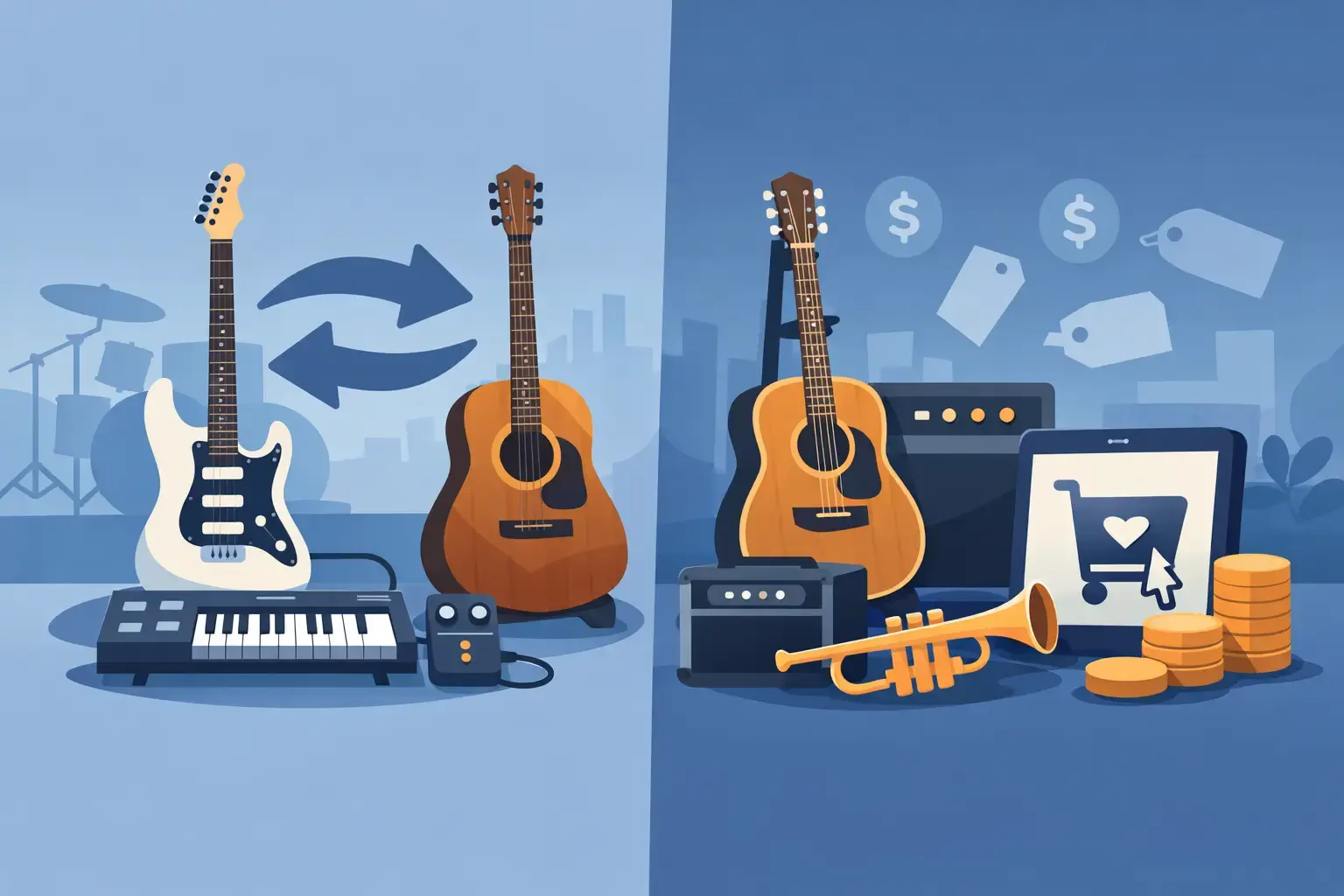
Gear Swap Versus Selling for Working Musicians
Published on August 11, 2026That pedal you loved for two years may be the exact piece another player needs right now. The real question in a gear swap versus selling decision is not whether your unused gear has value. It is whether cash or a better-fit piece of gear will move your setup forward faster.
For musicians, gear rarely leaves the rig because it is broken or worthless. A guitarist outgrows an amp that no longer fits the venues they play. A producer realizes a synth is inspiring but not practical for their workflow. A drummer needs compact hardware more than another cymbal. Selling is the familiar answer, but swapping can be the smarter move when the goal is to change your sound without draining your budget.
Gear Swap Versus Selling: Start With Your Actual Goal
Selling works best when you need money more than equipment. Maybe a repair bill is coming, you are funding a new purchase, or you want to simplify your setup without bringing another item home. Cash is flexible. It can cover a different instrument, studio time, a flight case, or something entirely outside music.
A swap works best when you already know what is missing from your rig. If your overdrive has been sitting in a drawer because you need delay, or your large combo amp has become impractical because you need a pedalboard-friendly solution, a direct trade can skip several steps. You do not have to sell, wait for payment, pay selling fees, and then hope the right replacement is still available.
The difference is simple: selling converts your gear into buying power, while swapping converts it into usable gear. Neither route is automatically better. The right answer depends on how clearly you can define your next move.
Choose selling when flexibility matters most
A sale gives you a clean exit. You set a price, find a buyer, and walk away with cash. That can be especially useful for gear with broad demand, such as popular pedals, well-known guitars, microphones, or current audio interfaces. If the item is easy to price and easy to ship, selling may be the quickest path.
Selling also makes sense when you are uncertain about what you want next. Cash gives you room to research, play a few options, and avoid forcing a trade just because someone offers something interesting. Musicians are good at convincing themselves that an unfamiliar piece of gear is exactly what they need. A little distance can prevent another expensive experiment.
But cash sales have friction. You may deal with low offers, payment concerns, shipping costs, returns, and buyers who disappear after asking for twenty photos. On generic marketplaces, you may also spend more time proving that you are legitimate than actually completing a transaction.
Choose a swap when you want to keep momentum
A well-matched trade can preserve more value than selling first. This is particularly true with specialty gear, discontinued models, boutique pedals, vintage instruments, and equipment with a committed niche audience. The right person may value your item more than a typical cash buyer because it solves a specific need in their setup.
Swapping can also reduce the psychological hit of letting go. If a guitar, synth, or amp has real value but no longer earns its space, exchanging it for something you will use keeps the process focused on progress, not loss. You are not starting from zero. You are redirecting value already tied up in your rig.
That said, a swap only works when both sides agree on condition, value, and terms. A trade that looks even on paper can become uneven once one item arrives with undisclosed scratches, missing parts, noisy pots, or a power supply that was never included. Good trades are built on clear information, not assumptions.
How to Compare Trade Value and Cash Value
The sticker price on a new product is not the number that matters. For a fair gear swap versus selling decision, look at recent used-market prices for the same model in comparable condition. Then account for the details that can materially change value: original box, manuals, modifications, cosmetic wear, included accessories, service history, and whether the item is hard to replace.
Cash value is usually the amount you can realistically receive after fees, shipping, insurance, and the time it takes to find a serious buyer. Trade value can be slightly different because both people are avoiding some of those costs and are getting something they want. A small value gap is normal, especially if one party is taking on higher shipping costs or receiving an item with less demand.
Do not get stuck arguing over a $25 difference while ignoring a $150 difference in usefulness. If a trade gives you a piece of gear that immediately improves rehearsals, gigs, or sessions, it can be worth more to you than its resale estimate. Still, usefulness is personal. It should not become an excuse to accept a bad deal.
When values are not equal, a cash add-on can make the exchange fair. Keep it simple and document the agreed amount before either person ships. If the adjustment is substantial, ask yourself whether a sale and separate purchase would give you more options.
The Risk Is Different, Not Smaller
Many musicians assume swapping is riskier than selling because two items are moving at once. In an informal trade, that is often true. One person can ship late, misrepresent condition, or stop responding after receiving the other item. A direct-message agreement may feel friendly until something goes wrong.
Selling has its own risks. Buyers can claim a package arrived damaged, dispute a payment, request a refund after using the gear, or pressure you into accepting an unsafe payment method. Cash does not remove the need for clear terms and accountability.
The safer approach is to treat any person-to-person transaction like a real agreement. Use detailed, current photos and describe flaws plainly. Confirm the exact model, included accessories, serial number when appropriate, and operational condition. Agree on shipping method, insurance, signature requirements, and what happens if an item arrives materially different from the listing.
A music-specific marketplace can make that process less uncertain. Bartr is built around protected gear-for-gear exchanges, with structured terms, deposits, delivery confirmation, reputation signals, and human-led dispute support. Those safeguards matter because trust should not depend on who sends the most convincing messages.
Ask These Questions Before You List
Before choosing a sale or trade, get specific about the gear in front of you. Is it sitting unused because it is redundant, or because you have not given it a fair chance? Would the cash solve a real need, or would it quietly disappear into small expenses? Is there a replacement you would buy immediately if you had the budget?
Also consider how hard the item will be to replace. A common production pedal can usually be sold and repurchased later without much trouble. A favorite vintage amp, a discontinued synth, or a guitar with unusual feel may deserve more patience. If you would regret losing it, do not list it just because you are bored with your current setup.
Finally, be honest about transaction effort. Selling a heavy amp locally may be more practical than shipping it. Trading a rare pedal with a player across the country may be worthwhile if both sides use clear protections. The best route is the one that gets you to the right gear with a fair outcome and manageable risk.
Make the Next Move Worth It
Your rig does not need to stay frozen just because buying new gear is expensive. Selling can create flexibility. Swapping can put the value already on your shelf to work in a more useful way. Both are valid ways to reset a setup that no longer fits the music you are making.
The key is to trade or sell with intent. Price honestly, describe everything, protect the transaction, and focus on what will earn a place in your next rehearsal, session, or show. The best piece of gear is not always the one you own. It is the one you will actually use.