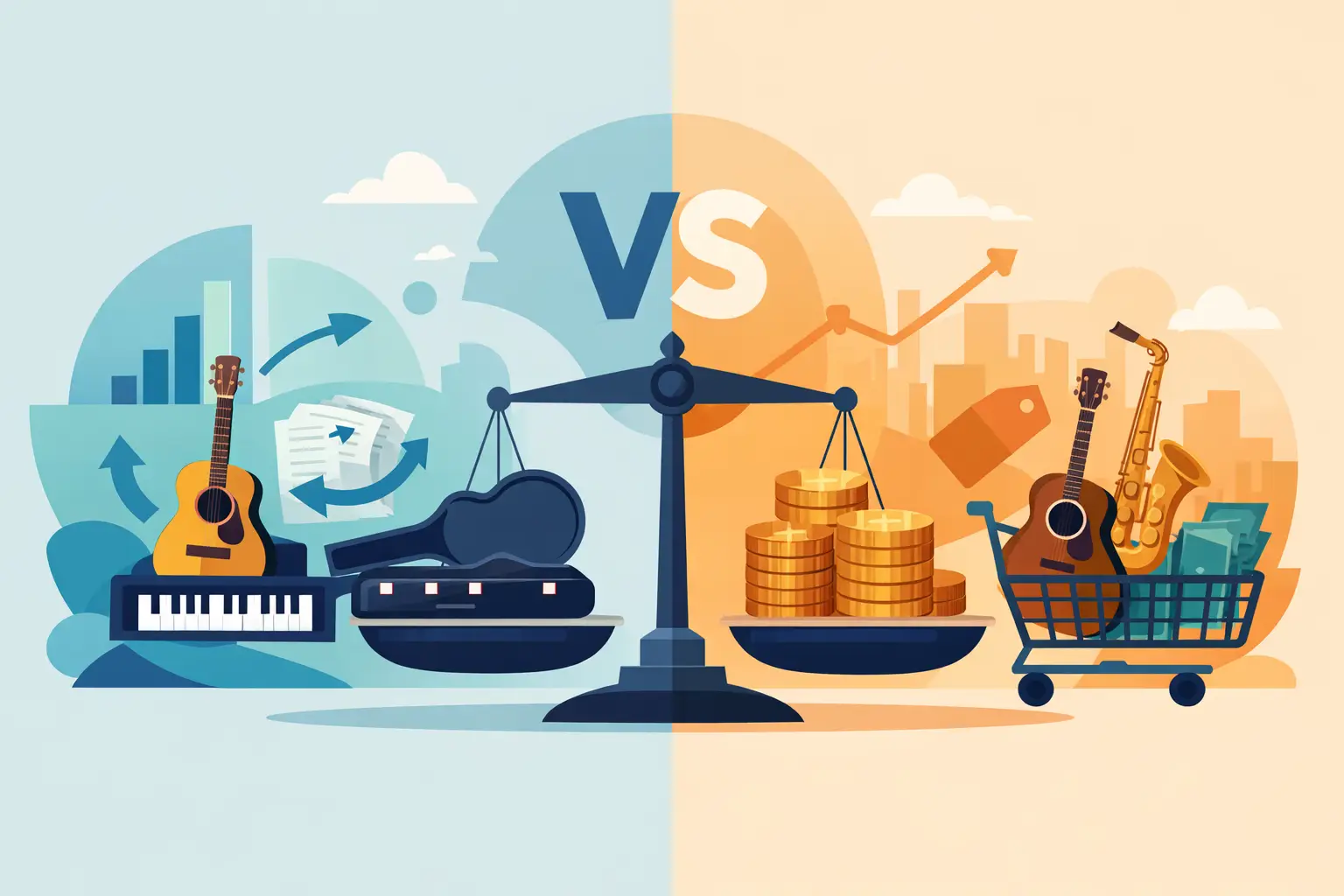
Instrument Swaps vs Selling: Which Wins?
Published on July 04, 2026You found a guitar you want, but the only way to fund it is the amp you barely use, the pedalboard you outgrew, or the synth that never quite fit your workflow. That is where instrument swaps vs selling becomes a real decision, not a theory. For most musicians, the right move depends on what you need most right now: cash, speed, flexibility, or a safer path to better gear.
Why instrument swaps vs selling is not a simple money question
On paper, selling looks cleaner. You list your gear, agree on a price, get paid, and use the cash however you want. If your goal is to cover rent, pay for a session, or fund one very specific purchase, that freedom matters.
But musicians do not always operate on paper. Gear value is weirdly fluid. One player sees an old delay pedal as clutter. Another has been hunting that exact version for months. A direct swap can cut through the usual gap between what sellers ask, what buyers offer, and what platforms skim off the top.
That is why comparing swaps and sales only by sticker price misses the point. The better question is what kind of transaction gets you to the next setup with the least friction and the least risk.
Selling gives you cash, but usually costs more time
Selling is still the default because cash is simple. It gives you options. You are not limited to whatever another person has available, and you are not trying to line up two pieces of gear with roughly equal value.
The catch is that selling often takes longer than people expect. You need photos, a fair price, a description that answers obvious questions, and enough patience to deal with lowball offers, ghosting, and buyers who want a discount because of a tiny scratch near the input jack. Even when you find a serious buyer, you still have to work through payment, shipping, or pickup.
There is also a hidden math problem in most sales. If you sell a piece of gear for cash and then turn around and buy another one, you are doing two separate transactions. That can mean two rounds of fees, two rounds of shipping, and two chances for something to go sideways. A sale may feel cleaner at the start, but it is not always the shortest route to the gear you actually want.
Swapping can preserve value better than selling
A good trade can be surprisingly efficient. Instead of discounting your gear until someone bites, you match it against another musician’s gear that holds similar practical value. That can work especially well with instruments and studio equipment where used-market prices vary by condition, region, demand, and timing.
Say you have a mid-tier guitar that no longer fits your style, and someone else has a comparable bass they are ready to move. If both of you were forced to sell first, each of you might take a price cut just to keep things moving. In a swap, you may land closer to the real value of the gear because neither side is trying to create cash liquidity first.
That does not mean swaps always come out ahead. If your item is highly desirable and easy to sell, a straight sale might produce stronger value. The same goes for rare gear that commands a premium with the right buyer. But for common categories like pedals, amps, entry to mid-level guitars, synths, and recording gear, swapping can reduce the usual losses that happen when musicians churn through equipment.
The biggest difference is often risk
This is where the conversation changes. Selling and swapping both involve strangers, but swaps usually create more moving parts. Two items need to be described accurately. Two shipments need to arrive. Two people need to follow through. If one side flakes, misrepresents condition, or sends the wrong item, the whole deal gets messy fast.
That is why a lot of musicians avoid trades even when trading would make more sense financially. Informal swap deals can feel like trust exercises with expensive consequences.
Selling has its own risks, of course. Fake payment screenshots, chargebacks, no-shows, and vague promises are familiar problems on generic marketplaces. But unstructured swaps can be worse because there is no standard process holding both sides accountable.
A safer swap setup matters more than people think. Structured terms, delivery confirmation, user reputation, and human dispute handling are not extras. They are the difference between a smart trade and a story you tell your bandmates about getting burned.
When selling is the better move
Selling makes more sense when your priority is flexibility. If you need cash for something outside your rig, a trade will not help. The same goes for situations where you are downsizing and do not want more gear coming in.
It is also a stronger option when your item has broad demand and a clear market price. A popular audio interface, a widely used amp head, or a clean, in-demand guitar model may sell quickly if priced right. In those cases, the extra work of finding the perfect trade match may not be worth it.
Selling can also be better if you are highly specific about what you want next and it is not commonly available in trade circles. Cash widens your options. You are not waiting for the one person with the exact snare, preamp, or poly synth you want who also happens to want what you have.
When swapping is the smarter move
Swapping shines when your goal is not cash. If you simply want different gear that better fits your sound, your sessions, or your live setup, a trade can get you there faster.
This is especially true for musicians who are experimenting. Maybe you are moving from board-heavy guitar tones into a simpler amp-and-boost rig. Maybe your home studio needs a drum machine more than another microphone. Maybe your semi-hollow does not get played because every gig calls for a harder-working solid body. Those are all trade scenarios.
Swapping can also reduce decision fatigue. Instead of selling one item, holding cash, comparing listings, and hoping you buy the next piece at the right time, you solve the before and after in one move. For players who rotate gear often, that matters.
And if the trade happens in a platform designed specifically for musicians, the whole process gets less chaotic. A marketplace like Bartr is built around the reality that gear-for-gear deals need more structure than a casual classified ad. Deposits, confirmations, reputation signals, and real human support make swaps feel viable for people who would otherwise avoid them.
The trade-off most musicians miss
The real trade-off is not swaps versus sales. It is optionality versus efficiency.
Selling gives you maximum optionality. You can take the cash and do anything with it. But that flexibility often costs time, energy, and value leakage.
Swapping gives you more efficiency if your end goal is another piece of gear. You skip steps. You may preserve more value. You stay inside the used-gear economy instead of repeatedly converting gear to cash and back again. But you give up some freedom because the deal has to match both sides.
That is why the right answer changes based on the item and the moment. A producer replacing one outboard unit with another may benefit from a direct swap. A drummer clearing out an extra kit to pay for moving expenses should probably sell. A guitarist who is curious about a new amp flavor but does not want to spend fresh cash is almost built for trading.
How to decide without overthinking it
Start with your actual goal, not the item itself. Ask whether you want money or different gear. That one question removes a lot of noise.
Then look at demand. If your item sells fast and predictably, selling may be painless enough. If it sits in the middle of the market with plenty of comparable listings, a swap could produce a better result.
Finally, be honest about your risk tolerance. If you are trading with strangers, protection matters. A process with clear terms and accountability is not just more convenient. It is what keeps a good idea from turning into a bad transaction.
Musicians change gear for good reasons. Your setup evolves, your sound shifts, your gigs change, and sometimes a piece that once felt perfect just stops earning its space. The smartest move is the one that gets you closer to the right rig without wasting time, value, or trust.