The Trusted Guitar Trade Process, Explained
Published on July 20, 2026That vintage-style Telecaster may be exactly what you want. But if the other trader has two blurry photos, a brand-new profile, and wants you to ship first, the excitement can disappear fast.
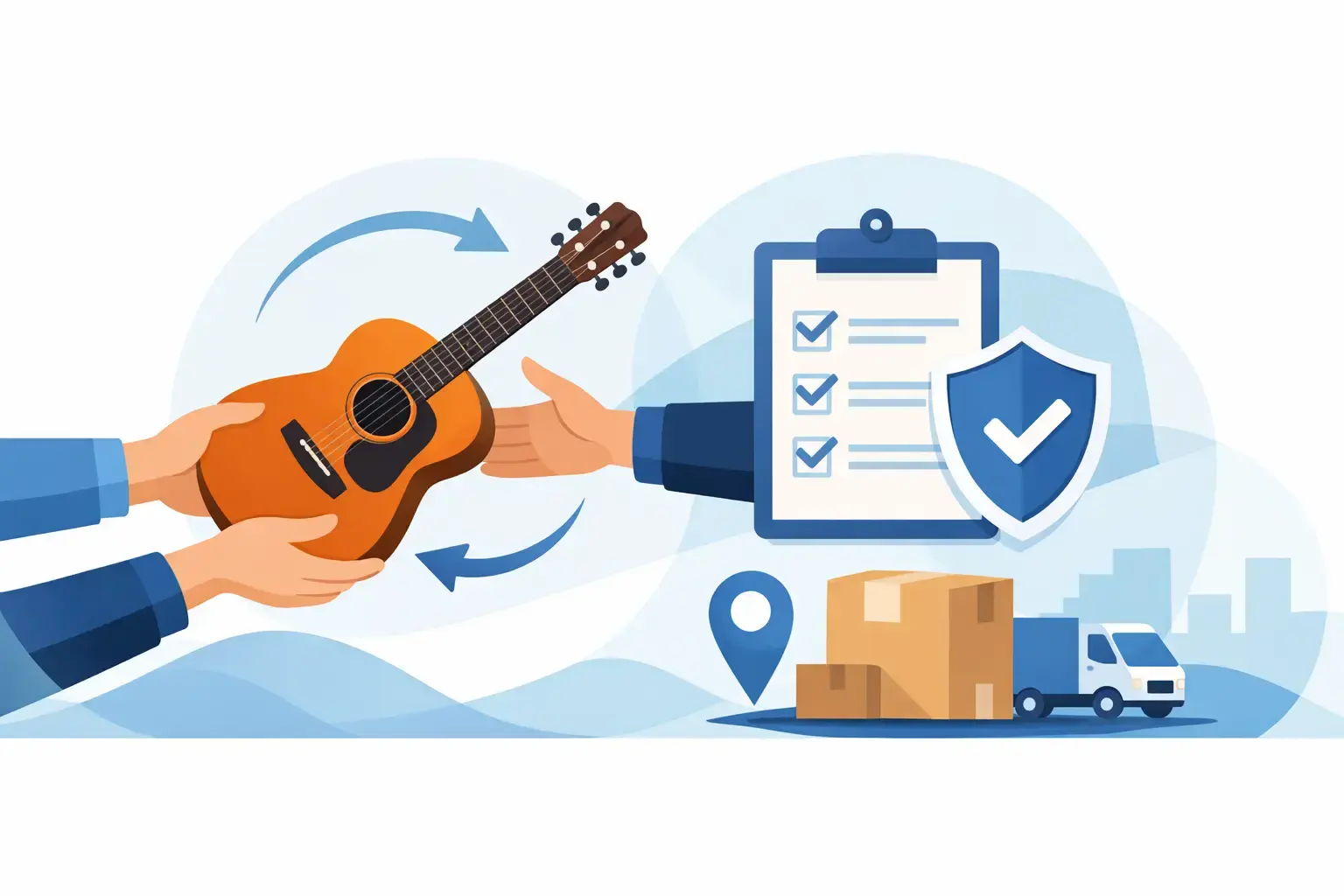
A trusted guitar trade process gives both players a clear path from first message to confirmed delivery. It replaces vague promises with documented condition details, agreed values, deposits, tracking, and a fair way to resolve problems if the guitars that arrive are not the guitars that were described.
For musicians, that structure matters because a guitar trade is rarely a simple one-for-one exchange. You are comparing value, condition, shipping risk, and the personal reality that somebody has to send a prized instrument to a stranger. A better process does not remove every risk. It makes the risk visible, shared, and manageable.
Why informal guitar trades break down
Most bad trades do not begin with an obvious scam. They start with assumptions. One person thinks “excellent condition” means a few scratches. The other expects a near-mint guitar. One trader assumes the case is included. The other considers it a separate part of the deal. Then shipping labels get delayed, messages slow down, and both sides wonder whether they made a mistake.
Informal classifieds and social groups can work when you know the other person or can meet locally. But a direct-message trade has no built-in structure when communication stops or an item shows up with an undisclosed crack, a swapped part, or a bad neck. Screenshots of a conversation are not the same thing as a process with terms everyone accepted.
A protected trade sets expectations before either guitar leaves home. That is not red tape. It is what lets both musicians focus on the gear rather than second-guessing the person on the other end.
What a trusted guitar trade process looks like
A reliable trade should move through distinct checkpoints. Each one answers a question that can otherwise create a dispute later: What is being traded? What is it worth? Who is responsible for shipping? What happens if something goes wrong?
1. Build listings around condition, not hype
A useful guitar listing does more than name the model and say it plays great. It gives the next owner enough information to make a real decision. Include the year if known, serial number details where appropriate, modifications, fret wear, neck condition, electronics issues, repairs, finish damage, and everything included in the trade.
Photos should support the description, not replace it. Clear shots of the front, back, headstock, neck, frets, case, and any wear points prevent the most common “I didn’t know about that” arguments. For higher-value instruments, a short video showing the guitar plugged in can add confidence, especially when pickups or controls are part of the guitar’s value.
Honesty is practical here. A disclosed ding is usually not a deal breaker. An undisclosed ding can stop a trade cold.
2. Agree on value and any cash difference
Two guitars can be worth roughly the same amount while still being a bad trade for one player. Condition, original parts, included cases, demand in a particular market, and shipping costs all affect the real value. A 1990s American-made guitar with replacement pickups is not valued the same way as an all-original example, even if both play beautifully.
If one side adds cash, write down the exact amount and who pays any shipping or platform costs. Do not leave it at “we’ll figure it out.” A small cash difference can become a major source of friction when it is never clearly confirmed.
There is no single perfect valuation method. Recent completed sales are more useful than optimistic asking prices, but condition and local demand still matter. The goal is not to prove that your guitar is objectively better. The goal is to reach terms both traders understand and accept.
3. Put the terms in one place before shipping
A trade agreement should state the exact items, their agreed values, any cash added, included accessories, shipping method, and the condition disclosures each person has reviewed. It should also say what happens if an item arrives damaged, materially different from its listing, or does not arrive at all.
This step protects good-faith traders as much as it discourages bad actors. When details are documented, nobody has to rely on memory or scroll through scattered messages to find what was promised.
A platform designed for gear swaps can make this easier by keeping the listing, terms, communication, and transaction record together. Bartr, for example, adds structure around the trade rather than asking two strangers to create their own safeguards from scratch.
4. Use deposits to create mutual accountability
A deposit is not a penalty. It is a shared commitment that says both people are serious about completing the trade under the agreed terms. It helps prevent ghosting after one trader has boxed up a guitar, bought insurance, or turned down another offer.
The details matter. Both parties should know how much the deposit is, when it is held, when it is released, and what circumstances could affect its return. A fair system treats both sides equally. If either person fails to ship without a valid reason, there should be a clear consequence. If a legitimate problem occurs, there should be a documented path to review it.
Deposits will not make sense for every local, face-to-face exchange between established musicians. For a cross-country trade with people who have never met, they are a sensible layer of protection.
5. Pack, insure, and document the shipment
A guitar can survive shipping well, but only if it is packed for the job. Loosen the strings slightly, support the headstock and neck, secure the guitar in its case, and use a properly sized outer box with enough padding to prevent movement. A gig bag alone is rarely enough protection for a valuable instrument moving through a carrier network.
Before sealing the box, take timestamped photos of the guitar’s condition, its serial number if applicable, the case, the packing materials, and the final package. Keep the shipping receipt, tracking number, and insurance information. This is not about assuming the other trader will act unfairly. It is about having facts if a carrier damages or loses the package.
Both people should ship by the agreed deadline and provide tracking promptly. Delivery confirmation closes the gap between “I sent it” and “it arrived.” For expensive guitars, signature confirmation may be worth the added cost.
6. Inspect before calling the trade complete
When the guitar arrives, inspect it promptly. Compare the serial number, finish, hardware, accessories, and disclosed wear against the listing. Check the neck, frets, electronics, tuners, and controls. If possible, play it through an amp before confirming completion.
Be reasonable about what counts as a problem. A faint finish mark that was clearly photographed is not the same as a cracked headstock, undisclosed repair, or a different model than the one agreed upon. A trusted process needs room for normal used-gear realities while holding traders accountable for material misrepresentation.
If there is an issue, document it immediately with photos and video, keep the packaging, and raise the concern through the transaction process rather than escalating through accusations. A human-led dispute review can assess the listing, terms, shipment records, and evidence from both sides. That is far more useful than trying to win an argument in a comment thread.
Reputation helps, but it is not enough by itself
Reviews and reputation scores give useful context. A musician with a consistent record of accurate listings, fast shipping, and fair communication is generally a safer trade partner than someone with no history or repeated complaints. Still, reputation should support the process, not replace it.
Even a well-reviewed trader can make an honest mistake, and a new user may be completely legitimate. Clear listing standards, documented terms, deposits, confirmation steps, and accessible support protect both groups. The safest marketplace is not one that assumes every member is perfect. It is one built to handle the moments when a trade does not go as planned.
A good trade should feel exciting, not uncertain
Trading guitars is one of the best ways to reshape your sound without paying full retail every time your tastes change. You might move from a high-output solid body to a semi-hollow, trade a collector piece for a road-ready workhorse, or finally find the instrument that fits the songs you are writing now.
The right process keeps that possibility open without asking you to ignore obvious risks. Share the details, agree to the terms, protect the shipment, and give both sides a fair way to be heard. When the trade is built on accountability, opening the case at the end can feel like the fun part again.